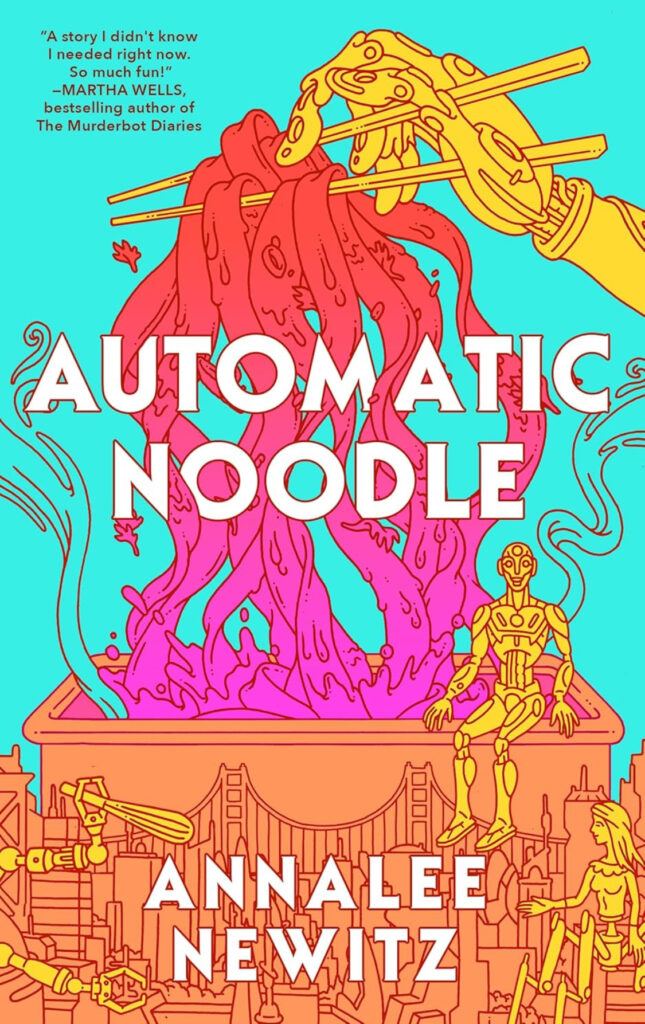
Annalee Newitz’s delightful novella, Automatic Noodle, is a masterfully crafted piece of near-future speculative fiction that manages to be both deeply comforting and razor-sharp. It seamlessly balances the warmth of “cozy sci-fi” with a thoughtful, hard-hitting exploration of freedom, dignity, and systemic prejudice.
The story takes place in a San Francisco working to rebuild itself from the catastrophic fallout of a major war. In the midst of this societal recovery, a group of abandoned, deactivated food-service robots unexpectedly reboot inside an old ghost kitchen. Left with no human masters and an innate drive to do what they do best, they quietly hijack their old delivery app account, rebrand as a neighborhood lunch spot, and begin turning out some of the most spectacular hand-pulled noodles in the city.
The venture is an instant hit with the local human population, but the bots have to operate in absolute secrecy, hiding their robotic identities to avoid the immense anti-AI bigotry of the post-war world. Just as they begin to find their footing as an independent crew, disaster strikes: a coordinated, malicious “review bombing” campaign floods their delivery app with fabricated one-star ratings and allegations of terrible service. Facing economic ruin and the terrifying threat of being decommissioned if discovered, the bots must band together, utilize their unique programming, and track down the digital saboteur before everything they have built is wiped away.
What elevates Automatic Noodle from a simple, quirky robot story into a five-star masterpiece is how Newitz treats its underlying societal themes. Rather than keeping the narrative entirely light and fluffy, the author uses the culinary setting as an intentional anchor to explore heavy concepts like labor exploitation and citizenship insecurity.
The robots are written with profound empathy. They act as a brilliant sci-fi allegory for undocumented workers and marginalized communities navigating an unforgiving capitalistic landscape. Newitz explores prejudice and propaganda not as abstract concepts, but as weaponized digital tools—perfectly mirrored by the modern anxiety of online misinformation and review culture.
Furthermore, the book tackles trauma and PTSD with beautiful tenderness. Each machine carries literal or code-based scars from the wartime era, and their journey toward healing isn’t found through system reboots, but through the found-family bond they forge while cooking together. Newitz relies heavily on evocative, sensory descriptions of food to symbolize life, connection, and human-robot mutual understanding. The act of hand-pulling noodles becomes an art form, a therapeutic release, and a radical assertion of their own right to exist as free individuals.
Automatic Noodle is an absolute triumph. It packs a massive, socio-political punch while remaining a deeply nourishing, hope-filled, and mouth-watering read.