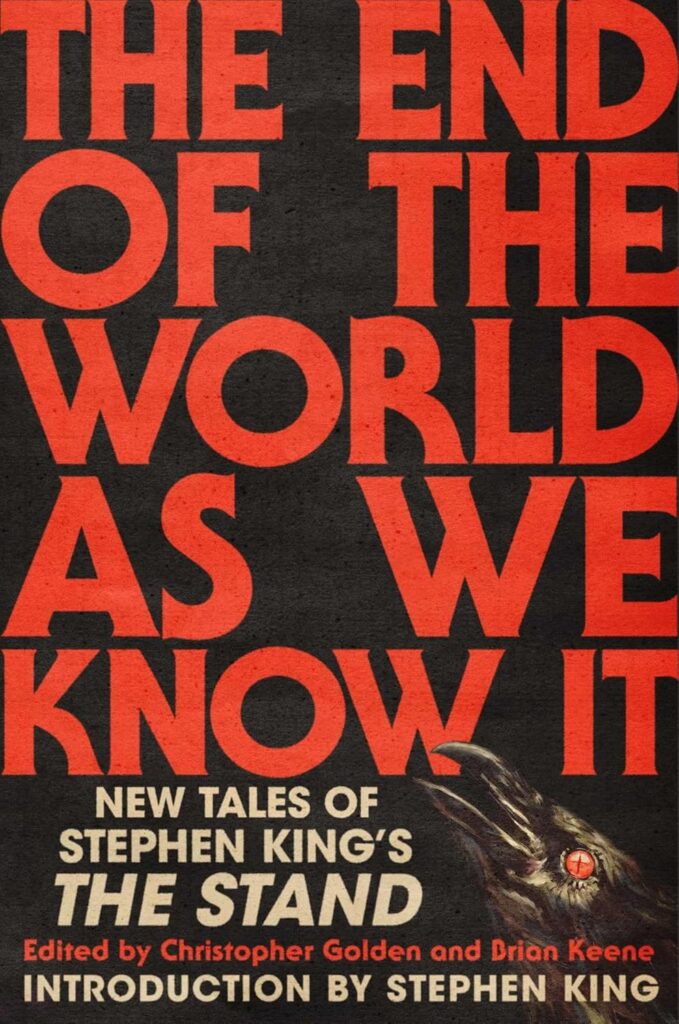
There’s a particular kind of vertigo that comes from opening an 800-page anthology set in one of horror fiction’s most beloved universes. The Stand is at turns tragic and funny, romantic and gross, sentimental and nihilistic — a pandemic story, a Christian allegory, and an attempt to craft a distinctly American epic fantasy all at once. Matching that range across 34 stories by 36 different writers is an almost comically ambitious undertaking. The End of the World As We Know It doesn’t fully pull it off. But it comes closer than it has any right to.
Stephen King authorized this return to the harrowing world of The Stand, edited by Christopher Golden and Brian Keene, featuring all-new stories set during and after — and some perhaps long after — the events of the original novel. It’s broken into four parts: Down With the Sickness, The Long Walk, Life Was Such A Wheel, and Other Worlds Than These — meaning you’re getting stories from every era and some you won’t see coming. Newcomers are welcome, though King’s sprawling original is prerequisite reading for anyone who wants the full emotional register of what’s being attempted here. Bloody Disgusting!
The collection’s most consistent emotional thread is the one The Stand itself tautened first: in a world stripped of infrastructure, who do you trust with your life? Resources become scarce and people become desperate fast. In a world gone to hell, each story intentionally walks down that path — who can you trust? What would you do? Fight to survive, no matter what that means? Or end it? The anthology’s best entries make this question feel genuinely unanswerable. Desperation here isn’t romanticized; it’s depicted as the thing that makes people monstrous and occasionally miraculous in equal measure, sometimes within the same page.
The gravitational war between Randall Flagg and Mother Abigail — darkness and light, destruction and preservation, fear and faith — charges The Stand with an almost mythological voltage. The anthology returns to this repeatedly. Wayne Brady and Maurice Broaddus’s “Abigail’s Gethsemane” is the only story to feature Mother Abigail as its central character, moving between 1919 and her journey into the wilderness outside Boulder in the fall of 1990. It’s heartfelt and intense, highlighting America’s ugly history with racism and the way Flagg exploits it. That choice — Flagg or Mother Abigail, annihilation or community, black or white — recurs across multiple entries, serving as the engine for Tananarive Due and Steven Barnes’ “The Boat Man” and Paul Tremblay’s standout “The Story I Tell is the Story of Some of Us.” The binary never grows stale because each writer finds a different human face for it.
Where the anthology finds genuinely new ground — and where it earns its better moments — is in attending to those The Stand itself couldn’t linger on: the survivors who survive quietly, without prophecy or purpose, simply enduring the wreckage of ordinary life. Hailey Piper’s “Prey Instinct” takes you into the brutal reality of going mad in a world that doesn’t give a fuck. Bev Vincent’s “Lockdown” is a stark survival story of Maine island life — small-scale, unglamorous, achingly human. These stories don’t ask whether good or evil will win. They ask what it costs to wake up again after everyone you loved is gone, and whether that cost is survivable.
The anthology is at its most moving when hope arrives not as resolution but as a fragile, almost embarrassing thing — something characters reach for despite knowing better. Alex Segura’s “La Mala Hora” is all about having a little hope when there is zero to be had, sweet and comforting. Bryan Smith’s “Every Dog Has Its Day” runs eerily parallel to Harold Lauder’s tragic arc in the most uplifting way possible. And Gabino Iglesias’ “The Hope Boat” makes the bleakly beautiful case that sometimes hope is often just a mirage — a counterweight that keeps the optimistic entries honest. The collection earns its more redemptive moments precisely because it doesn’t flinch from the possibility that there may be nothing to redeem.
This tension — between the grand sweep of civilizational collapse and the intensely private experience of being alone in it — is where the anthology is most thematically interesting and most structurally uneven. The editors ensure thematic coherence, alternating between personal tragedy and large-scale apocalypse, echoing King’s balance of the intimate and the epic. But not every story can sustain both registers. Tim Lebbon’s “Grace” takes the reader into space for the plight of astronauts trapped during the Superflu — genuinely disorienting macro-scale horror — while the more personal survival stories, like Alma Katsu’s “Make Your Own Way” (a farm girl, an elderly horse, and the apocalypse), prove that the finest moments here are almost always intimate. When the anthology zooms out too far, the human stakes blur. When it stays close, it devastates.
Some contributions feel derivative compared to King’s original power, and at 800 pages, the collection asks for a patience that not every entry justifies. Some stories feel like true continuations; others read like playful experiments that haven’t quite earned their place at this particular table. The anthology’s sheer size is its greatest virtue and its most persistent problem: the curation is strong, but the sprawl will lose readers who might have loved a leaner version of the same project.
The End of the World As We Know It is not the equal of The Stand. Nothing is. But at its best — in its quiet portraits of the isolated and the grieving, its refusal to let either hope or despair win cleanly, its willingness to sit with the people the apocalypse left behind rather than the ones it chose — it earns its place in the same universe. There are genuine gems here, whether you’re looking for stories that feel just like The Stand, examine it critically, or build out from it. For the devoted Constant Reader, it’s essential. For everyone else, it’s very good, in patches, if you’re patient enough to find them.