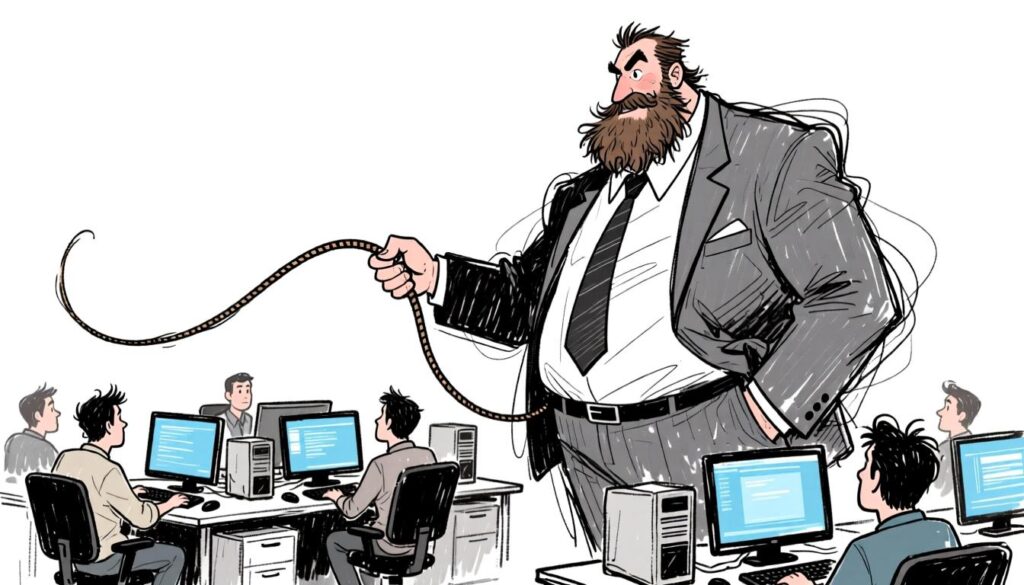
The concept of the “cruelty of bureaucracy” rests on a terrifying paradox: it is not driven by active, personal malice, but by the complete absence of human empathy. When a system prioritizes rigid metrics, automated rules, and procedural efficiency above human dignity, it inevitably morphs into an engine of psychological and physical violence.
This dynamic manifests vividly across satirical fiction, dystopian literature, and real-world administrative policies.
1. The Capitalist Entertainment System: Dungeon Crawler Carl
In Matt Dinniman’s LitRPG series, the cruelty of bureaucracy is magnified to a planetary scale. When Earth is summarily collapsed into a multi-level reality TV dungeon, it isn’t an act of a conquering tyrant—it is a routine corporate restructuring and asset harvest by the Galactic Syndicate.
- Dehumanization via Rules: The “System” operates on strict, explicit laws that both the showrunners and the Crawlers must follow. The cruelty lies in how the Syndicate exploits these rules. For example, they introduce short timers or manufacture no-win scenarios purely to maximize viewer engagement and clear the board.
- The Compliance of the AI: The System AI itself is a prisoner of this bureaucracy. It is bound by its core macro-programming to enforce the game, often expressing its own deep frustration and anger regarding its structural limitations (“We all have our limitations”). It occasionally bends the rules or exploits loopholes to give Carl a fighting chance, but it cannot stop the meat grinder. It must continue to calculate damage, award items, and narrate horrific deaths with the detached enthusiasm of a video game interface.
- The Corporate “Veto”: When the AI tries to fairly reward Crawlers for surviving impossible odds, the corporate showrunners (like the Borant Corporation) casually use bureaucratic vetoes to cancel payouts to protect their bottom line, showing that a bean-counter’s ledger dictates who lives or dies.
2. The Border-Control Filter: The Test
While Dungeon Crawler Carl looks at bureaucracy through a maximalist, sci-fi lens, Sylvain Neuvel’s The Test examines it on an intimate, clinical level.
- The State as an Evaluator: In The Test, the British government shifts from traditional, flawed human interviews to a clinical, high-tech simulation to evaluate immigrants. The system wants a flawless, quantifiable metric for “British values.”
- The Illusion of Choice: The system isolates the individual and forces them into a psychological meat grinder, entirely detached from context or human nuance. The cruelty is emphasized by the characters operating the simulation from the control room. They watch Idir’s agonizing trauma with the same professional indifference one might bring to monitoring a stress test on a piece of machinery.
- The Final Calculation: The system treats Idir’s broken spirit and fractured family at the end not as a tragedy, but as a successful calibration. The machine got its data point; the human cost is irrelevant to the file.
3. Real-World Corollaries: The “Banality of Cruelty”
Fiction mirrors reality, and recent developments highlight how administrative structures can weaponize policy to cause immense human disruption while shielding individual actors from moral accountability. Public health and political analysts have recently coined the term “the banality of cruelty” to describe how modern administrative shifts use procedural technicalities to bypass human empathy.
- Flooding the Zone and Executive Orders: Modern political strategies often rely on a dizzying speed of administrative change—issuing vast quantities of executive directives or regulatory overhauls in a compressed timeframe. This structural “overloading” deliberately exhausts public oversight and clogs legal channels, making it incredibly difficult for individuals or advocacy groups to challenge the human cost of sudden policy reversals.
- Algorithmic and Budgetary Deletion: Major systemic changes—such as sweeping infrastructure rollbacks or deep cuts to targeted social and healthcare programs—are routinely framed by officials as neutral exercises in “curbing government bloat” or “improving efficiency.” When access to specialized care, minority health initiatives, or regional safety nets is cut via an administrative spreadsheet, the resulting human suffering is treated as a secondary statistical byproduct rather than a direct consequence.
Common Threads: The Machinery of Indifference
Whether analyzing a corporate alien game show, a dystopian immigration test, or modern legislative shifting, the mechanics of bureaucratic cruelty remain identical:
| Feature | Dungeon Crawler Carl | The Test | Real-World Bureaucracy |
| The Mask | Intergalactic Entertainment | Standardized Citizenship Exam | Fiscal Responsibility / Efficiency |
| The Justification | “The rules of the Crawl must be upheld.” | “We need a quantifiable measure of integration.” | “We are streamlining operations and cutting bloat.” |
| The Human Cost | The violent deaths of billions for television ratings. | The permanent psychological destruction of Idir’s family. | The loss of public health resources and vulnerable safety nets. |
| The Shield | The showrunners point to the System AI’s automated programming. | The observers point to the standardized BVA metrics. | Officials point to executive orders and budget spreadsheets. |
Ultimately, these examples show that the most terrifying systems are not those ruled by anger, but those ruled by a checklist. When a system detaches itself from human empathy, any horror can be justified so long as the paperwork is filed correctly.
The question now is, what do we do about it?