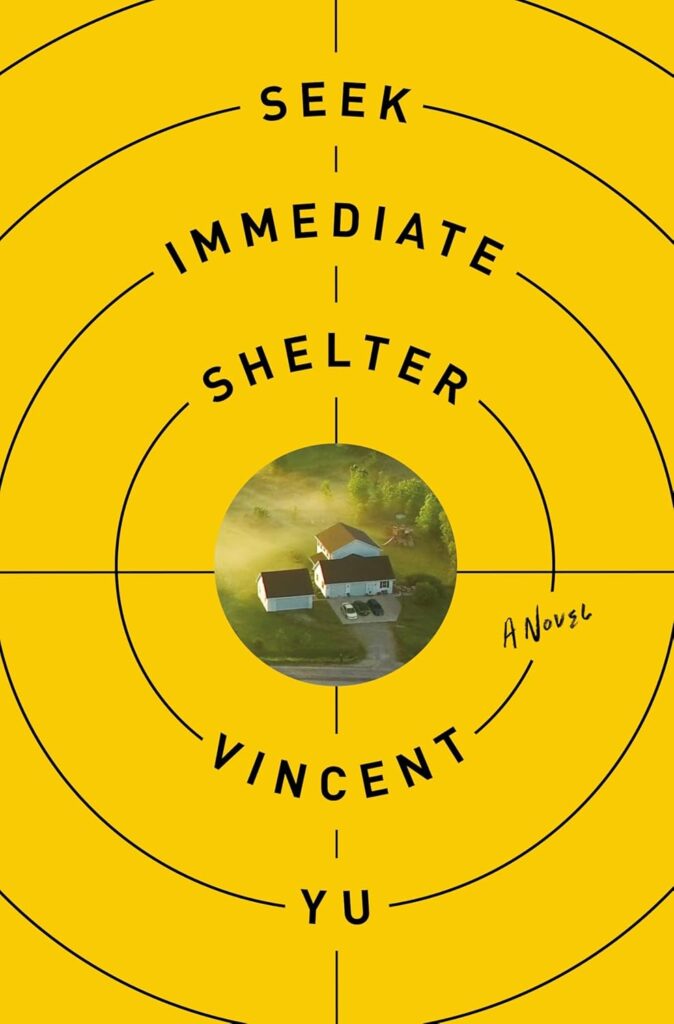
Okay, the premise alone got me: a small Massachusetts town gets a “BALLISTIC MISSILE THREAT INBOUND, SEEK IMMEDIATE SHELTER, THIS IS NOT A DRILL” alert, eighteen minutes of pure panic, and then… false alarm. Everyone’s fine. Except they’re not, because of what they did and said in those eighteen minutes.
That’s the hook, but the real book is about what happens after. Vincent Yu structures this as a series of linked stories, each one centered on a different Beckitt resident, and that structure is doing a lot of quiet work. You get a husband who bolts for his car instead of staying with his wife and kid. A mother who fires off a text to her daughter that she can never take back. A guy who finally confesses a love he’s been sitting on for years because, well, what’s the point of holding it in anymore if the world’s ending. None of it reads like a plot twist for shock value. It reads like the truth finally getting let out of the room it’s been locked in. Yu’s basically asking: is this who you really are, or is this just who panic makes you? And to his credit, he refuses to give you a tidy answer either way — the book seems to genuinely believe both things can be true at once, that the “real you” under pressure and the “performed you” in daily life aren’t opposites so much as two costumes for the same person.
The “illusion of stability” thread is maybe what stuck with me most. These are people who walked into that morning believing their marriages were fine, their friendships were solid, their lives were basically on track — and the missile alert didn’t so much break anything as reveal that it was already broken. The cracks predate the siren. That’s a much more interesting (and bleaker) idea than “crisis changes people,” and Yu commits to it. Nobody gets to blame the missile for who they turn out to be.
And then there’s the disconnection-within-community angle, which I think is underrated in how this book is usually pitched. Beckitt is supposed to be this tight-knit place — recurring characters, overlapping lives, the kind of town where everyone shows up in everyone else’s chapter eventually. But the linked-story format itself enacts the theme: people drift past each other, occupy the same spaces, sometimes share history, and still end up essentially alone in the moment that matters most. It’s a sneaky way to write a “community novel” that’s honestly more about how thin those community ties actually are once real fear shows up. I don’t think that’s an accident.
The back half settles into betrayal, forgiveness, and redemption, and this is where the book is at its most patient. Yu doesn’t rush anyone toward resolution. Some characters get years, not chapters, to even start repairing what they did — and a few don’t really get there at all, which I appreciated. It would’ve been easy to wrap every storyline in a bow once the “this is not a drill” tension cleared, and Yu mostly resists that.
My gripes are pretty minor in the scheme of things, but they’re there. With this many characters getting their own spotlight chapter, a few threads feel shortchanged — you can tell some of them were building toward something more and just got resolved a beat or two early, almost like the book ran out of structural room. And once the missile-alert urgency fades, a handful of the later, longer-aftermath chapters lose a bit of that electric, propulsive feeling the opening has, even though they’re arguably doing the more important emotional work. It’s a trade-off the structure sort of forces on itself.
Still — this is a genuinely strong, thoughtful debut, and one that’s less interested in the disaster than in everything the disaster accidentally exposed. If you’re into character-driven books that ask uncomfortable “who would you really be” questions and don’t let anyone off the hook too easily, this one’s worth the read.